Table of contents
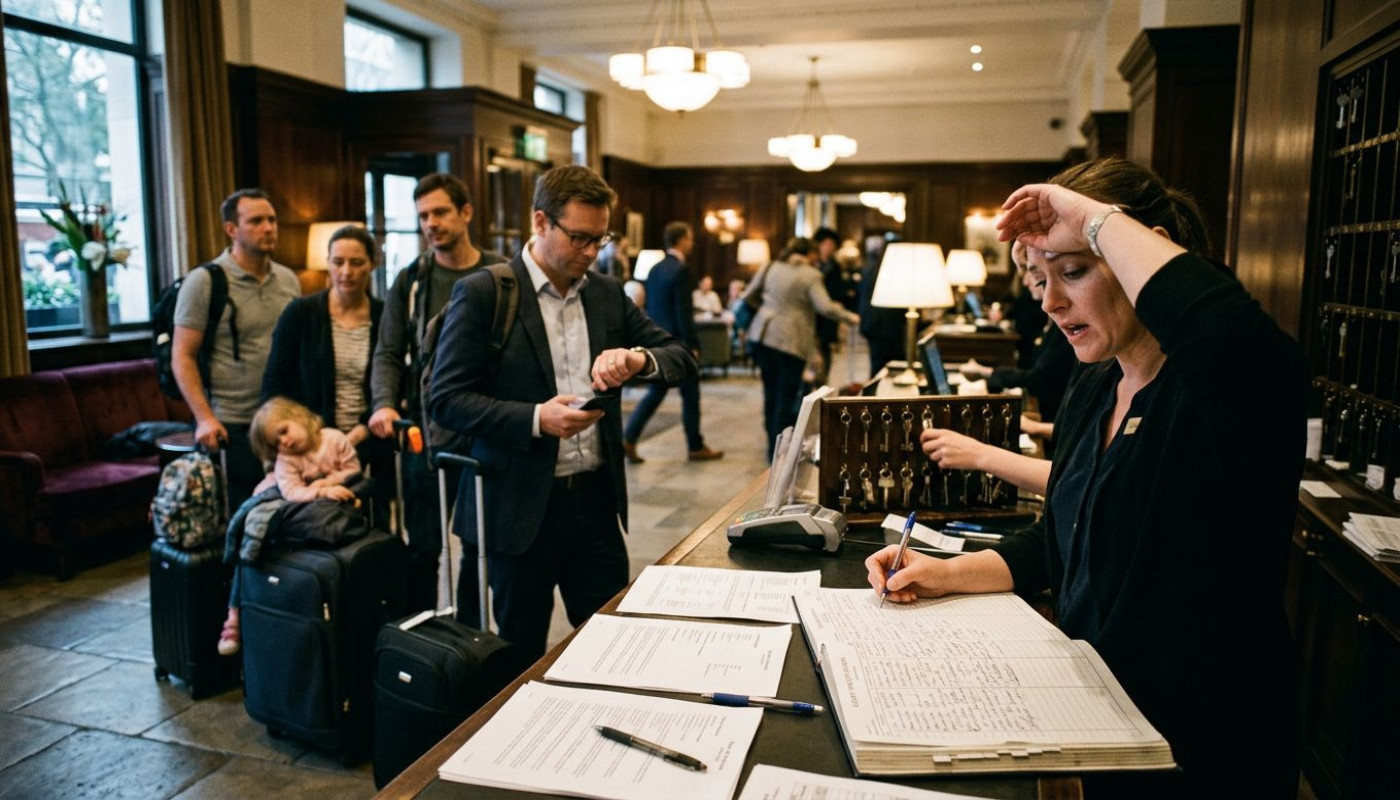
Queues at reception, late-night lockouts, lost keys, and staff stuck copying passport details, these are still daily scenes in short-term rentals and small hotels, even as guests now expect airline-level speed and clarity. Across the sector, labor shortages and rising wage bills are colliding with stricter identity rules and tougher online reviews. The result is a hidden bill that rarely appears on a P&L: the cost of not automating check-in, measured in hours, chargebacks, cancellations, and reputational drag.
The check-in bottleneck is eating margins
How expensive can “just checking someone in” really be? In a busy property, the answer is painfully concrete, because manual check-in is not one task, it is a chain of tasks, and every link consumes paid time while increasing the likelihood of human error. A typical arrival process can include pre-arrival messaging, ID collection, payment confirmation, key handover, Wi-Fi and house-rule briefing, and troubleshooting when something inevitably goes wrong. Industry research has repeatedly highlighted that front-desk and guest-services labor is one of the largest controllable costs in lodging; STR and other hospitality analysts routinely frame labor as a primary driver of profit pressure, especially as occupancy and average daily rate fluctuate. When staff spend their shifts on repetitive arrivals, they are not upselling late checkout, solving maintenance issues early, or responding quickly to high-value guest messages that protect ratings.
The margin impact is amplified by timing. Check-ins cluster into a narrow window, often between late afternoon and early evening, which forces properties to staff for peaks rather than averages. That means paying for coverage “just in case”, and absorbing overtime when flights are delayed or guests arrive after hours. Even without overtime, the hidden cost shows up as opportunity cost: a host who spends two hours each day coordinating arrivals is losing roughly 60 hours a month, the equivalent of more than a full workweek, time that could be redirected to revenue management, marketing, or owner relations. Scale that across a portfolio and the arithmetic becomes sobering: the manual process effectively taxes growth, because adding units adds arrivals, and arrivals demand people.
There is also the cost of mistakes, and it is not theoretical. A typo in a door code, a missed message thread, a misread booking note about accessibility, these small slips can lead to refunds, free nights, or the slow bleed of lower review scores. On platforms where ranking and conversion are tightly tied to guest feedback, a handful of poor arrival experiences can depress visibility and reduce future bookings. Automation does not eliminate problems, but it reduces the volume of avoidable ones, and it creates logs and standardized flows that make it easier to identify where issues originate, which is precisely what manual operations struggle to do.
Guests judge you in five minutes
First impressions are brutal, and in hospitality they arrive before anyone sees a room. The guest’s emotional verdict is often formed at the curb: Is the address clear? Does the door open? Is there a human they can reach? A frictionless check-in is not simply a convenience, it is part of perceived safety and professionalism, especially for families, solo travelers, and business guests arriving late. Studies on customer experience repeatedly show that consumers attribute outsized weight to negative events early in a journey, and the lodging world is no exception; a delayed entry can overshadow spotless linens and a perfect view.
The review economy turns that moment into a permanent record. A single line, “Check-in was a nightmare”, travels farther than any marketing copy, and it is increasingly common for guests to include operational details in public feedback, from unclear instructions to unresponsive messaging. Meanwhile, expectations have shifted. Keyless entry has moved from novelty to baseline in many markets, and travelers are accustomed to self-service flows used by airlines, ride-hailing apps, and modern hotels. When a property still relies on coordinated handovers and manual identity checks, it can feel outdated, even if the decor is brand new.
Automation also reshapes communication. Rather than a scatter of ad-hoc messages, structured pre-arrival sequences can deliver the right information at the right time, and prompt guests to complete steps before arrival, which reduces the number of panicked calls at the door. Crucially, it gives consistency across staff shifts and across properties, so the guest experience does not depend on who happens to be on duty. For operators managing multiple listings across platforms, consistency is not a “nice to have”, it is a brand defense mechanism, because variability is what creates surprises, and surprises are what guests punish.
Compliance and payments are getting tougher
Regulation is tightening, and the administrative load is rising with it. Many destinations now require stronger guest identification, registration with local authorities, or detailed record keeping, and enforcement has become more visible as cities attempt to manage the growth of short-term rentals. Even where rules are not new, audits and reporting demands can expose weak processes, and manual check-in often relies on informal habits: a photo of an ID stored in the wrong place, a spreadsheet updated days later, a verbal confirmation that cannot be proved. In a dispute, “we always do it this way” is not evidence.
Payments add another layer of risk. Chargebacks, disputed damage claims, and last-minute cancellations are costly not only because they can wipe out revenue, but because they consume staff time and require documentation. A streamlined, standardized flow can help ensure that security deposits, rental agreements, and house rules are acknowledged consistently, and that timestamps and message histories are preserved. That matters when a guest claims they never received instructions, or when a property needs to demonstrate that certain terms were accepted before arrival.
For teams looking to reduce manual exposure, tools and integrations have proliferated, and operators increasingly compare platforms based on how well they unify messaging, task management, and arrival workflows. A growing number of property managers evaluate options like Uplisting for automation to consolidate operational steps, reduce repetitive admin, and create a more defensible record of what was sent, when, and to whom. The practical payoff is not merely convenience, it is resilience: fewer loose ends, fewer compliance headaches, and fewer situations where a staff member’s memory becomes the system of record.
Automation pays back in staffing stability
Here is the question operators rarely ask: what is turnover costing you? Hospitality has long wrestled with retention, and the post-pandemic labor market has made recruiting and training even harder. Manual check-in amplifies the problem because it concentrates stress into predictable peaks, creates after-hours interruptions, and forces staff into repetitive work that offers little progression. When the job becomes “copy, paste, apologize”, burnout follows, and each departure triggers a new round of hiring, onboarding, and inevitable service inconsistency while newcomers learn the ropes.
Automating arrival workflows can change the shape of the workday. Instead of staffing heavily for the same check-in hour, teams can focus on exceptions, high-touch moments, and proactive maintenance coordination, which tends to improve both guest outcomes and staff morale. It also makes training faster. A standardized set of triggers, templates, and checklists reduces tribal knowledge, so new hires do not need to memorize dozens of property-specific quirks on day one. In practice, that can mean fewer mistakes, fewer urgent calls, and fewer “only Alex knows how to do this” dependencies that cripple operations when someone is sick or leaves.
Financially, the payback can be clearer than it first appears. Automation costs are typically fixed or scale gently, while manual labor scales linearly with bookings and portfolio size. In a high-season surge, that difference matters, because revenue may jump, but so do support requests, arrivals, and the number of opportunities for error. Operators who reduce manual steps often find they can grow without adding headcount at the same rate, or they can keep headcount stable while improving response times and review performance. Either way, they buy back the scarcest resource in the business: dependable human attention, deployed where it actually adds value.
What to do before the next high season
Book a short pilot now, and measure time saved per arrival. Set a realistic budget for software and smart locks, then map local rules on IDs and guest registration so the workflow stays compliant. Look for regional grants or energy-efficiency programs that sometimes offset connected hardware in hospitality, and lock in an implementation window before peak weeks, because the costliest check-in is the one that fails on a sold-out night.
On the same subject